
How Does Policy Enforcement Work in Enpass?
Enpass policy enforcement lets admins set security rules and apply them to every user automatically. Policies cover how vaults are shared, exported, and created; master password strength; auto-lock and clipboard behavior; compromised password detection; autofill restrictions; and password generation rules.
What admins can enforce
Policies are grouped into areas, each managed from its own section of the Admin Console.
| Policy area | What admins control |
|---|---|
| Business vaults | Who can share or export credential data, how data moves in and out of business vaults, and where vaults can be created |
| Vault encryption | Master password strength requirements, plus keyfile protection as an additional layer, if required |
| App security | Auto-lock behavior, biometric and PIN access, and clipboard handling on every device |
| Password audit | Compromised password detection, banned words, and SSO reuse tracking |
| Password autofill | Domains where autofill is restricted, and exceptions for internal HTTP sites |
| Advanced app | Import file handling, passkey management, and update notifications in MDM or UEM deployments |
| Password generation | Minimum length, complexity, and expiry requirements for passwords |
Full settings for each area are in the Enpass Help Center. Try them yourself with a 30-day free trial of the Enpass Business plan.
How policies are set and applied
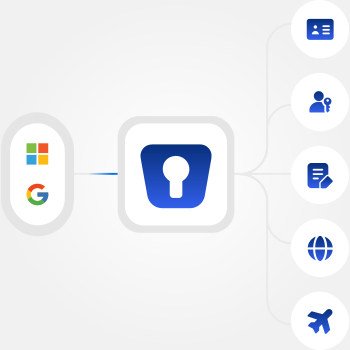
Every change is logged, and your vaults stay inside your own Microsoft 365 or Google Workspace environment throughout.
Supporting the frameworks you're audited against
Each policy area maps to controls that common frameworks and internal security policies ask for. Enpass policies help you meet those requirements as part of your wider compliance program.
| Policy area | Supports |
|---|---|
| Business vaults | Access control and data protection requirements in ISO 27001 and SOC 2 |
| Vault encryption | Password policy and cryptographic controls required by most frameworks |
| App security | Session timeout and endpoint security requirements in NIST, HIPAA, and SOC 2 |
| Password audit | Ongoing risk assessment and breach monitoring requirements |
| Password generation | Password composition rules in NIST and PCI DSS |
Every policy change on record
Every policy change is logged automatically, with what changed, who changed it, and when. When an auditor or a customer security questionnaire asks how credential policy is governed, the evidence is already in the policy history.
Policy changes also appear in Enpass event logs, so they reach your SIEM alongside everything else your security team monitors.

Live today, alongside the full admin stack
Policy enforcement runs in the Enpass Admin Console today, across every policy area, with group-level overrides. It's part of the same Enpass Business platform chosen by enterprises in regulated industries, including government organizations and Fortune 500 companies.
- SSO: Admins sign in to the Admin Console through your SAML 2.0 identity provider
- SCIM provisioning: Users are added and removed automatically from your identity provider
- SIEM integration: Event logs, including policy changes, flow to the SIEM you already run
- Admin Console: Policies, users, recovery, and password health are managed from one place
Insight for IT & Security Leaders

FAQ
Enpass admins can enforce rules across different policy areas: business vault sharing and export, master password strength, app security such as auto-lock and clipboard handling, password audit, autofill restrictions, advanced app settings including passkey management, and password rules. Policies are set once in the Enpass Admin Console and apply to every user by default.
Yes. Organization-level policies are the default for every user, and admins can override specific policies for individual groups without changing the defaults for anyone else. A team handling more sensitive credentials can run stricter export or auto-lock rules, for example, while the rest of the organization keeps the standard settings.
Yes. Policy enforcement is included in the Enpass Business plan, along with group policy overrides, policy history, event and audit logs, SSO, SCIM provisioning, and SIEM integration. Admins configure policies in the Enpass Admin Console. Larger organizations can add enterprise services such as custom solution design and a formal proof of concept.
Talk to us about your compliance and data sovereignty requirements